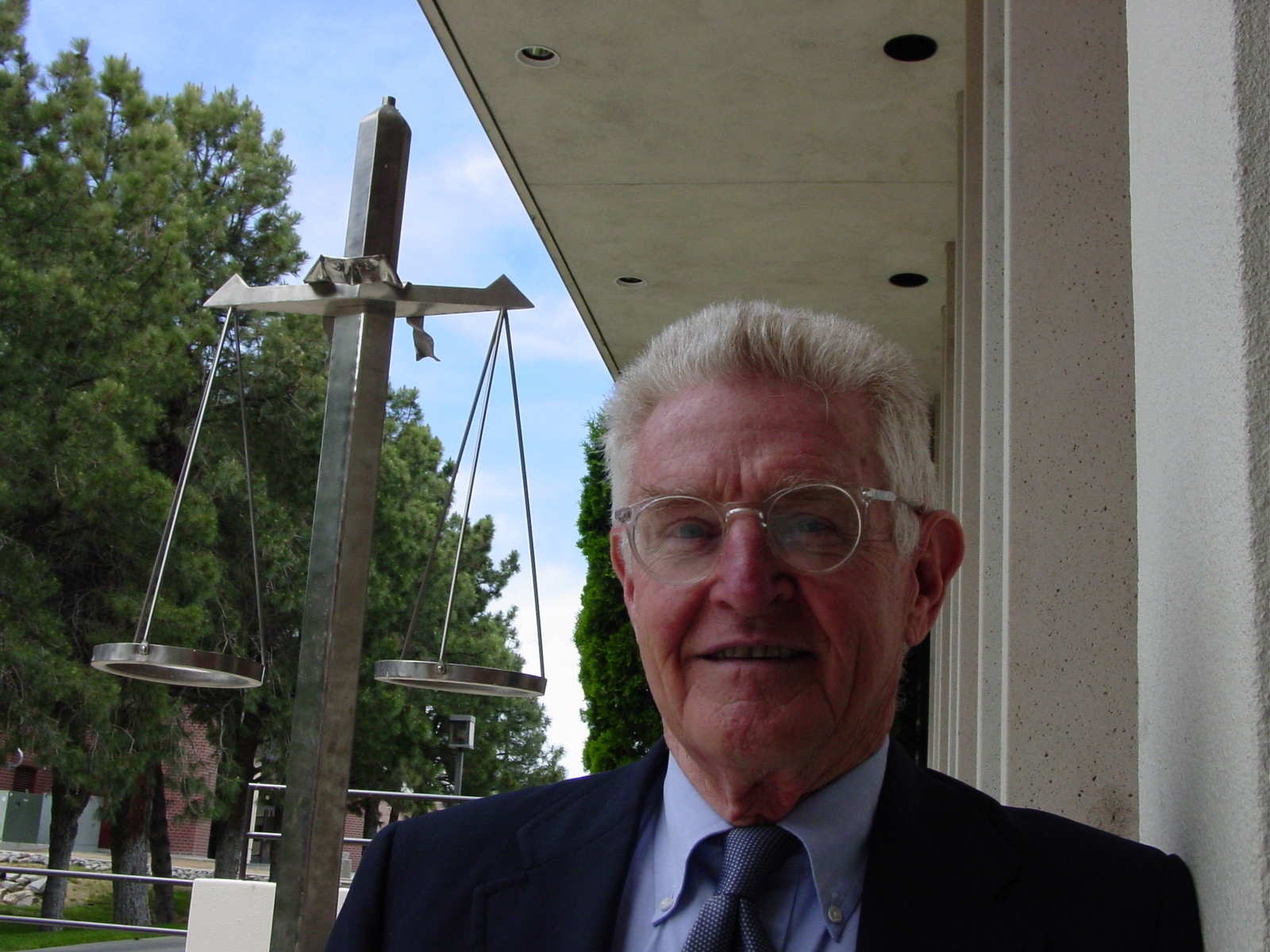
Ernest C. Friesen, Jr., the first dean of The National Judicial College, passed away on December 11, 2025, at the age of 97, only 18 months after the death of his beloved wife of 72 years, Corleta Friesen. In his remarkable life, he pioneered the field of court administration and left a durable legacy of crucial reforms of our judicial system. He was an idealist and a reformer, with a gift for getting to the heart of a problem and a passion for finding practical solutions he could teach the world.
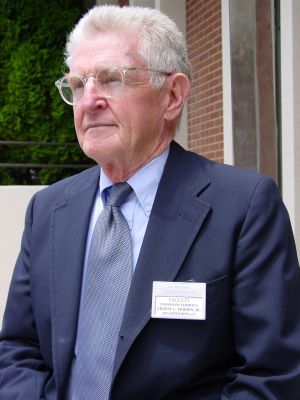
In addition to serving as the NJC’s first dean, he was a faculty member for six decades, teaching more than 80 classes, including courses he founded and created. He taught in General Jurisdiction, Effective Team Court Management, Effective Caseflow Management, Judicial Administration, Managing Trials Effectively as well as other courses and webinars focused on court administration. His last webinar was in 2023.
As a law professor in 1963, under the sponsorship of US Supreme Court Justice Tom Clark, he founded and served as dean of the National College of State Trial Judges, which today is the National Judicial College, where most judges go to learn best practices in managing their cases and protecting individual rights. In 1965, at age 37, he was appointed Assistant Attorney General of the United States under Ramsay Clark, where he vetted and qualified 129 federal judges, raising the standards for our federal judiciary. In 1966, he became the Administrative Director of the Federal Courts under Earl Warren, where he implemented broad reforms of our federal courts and created the professional position of court administrator. In 1970, he founded and ran the Institute for Court Management, one of the first non-profit organizations dedicated to improving the quality of our justice system. It improved the implementation of justice by introducing a cadre of professional court administrators trained in modern systems and management theory into court systems throughout the US.
His legislative accomplishments included drafting the Federal Magistrates Act, portions of the Speedy Trial Act, and promoting sweeping bail reforms. In all his advocacy and teaching, he lived and breathed the slogan, “Justice delayed is justice denied.” Today there are millions who were spared the corrosive and dehumanizing impact of court delay because of his leadership among thousands of judges and court administrators. Ernie is famous among judges and court administrators for a lecture he gave many times on the eight purposes of our courts. There is hardly a judge or court administrator alive today who is not aware of the seminal importance of his work.
Among his many publications, his book, Managing the Courts, remains a preeminent work on court administration. A leading award in the field of court administration is known as the “Ernie Friesen Award of Excellence,” presented to an individual who has demonstrated vision, leadership, and sustained commitment to the achievement of excellence in the administration of justice.
In his decades-long career, Ernest Friesen served as dean of two law schools and was tapped as a consultant for court systems in the Ukraine, Jordan, Bahrain and Haiti.
Ernie was born and raised in Hutchinson, Kansas during the depression as the fourth in a family of five children (a sister, Marybelle and three brothers, Hal, Wilbur and John). His father owned a business, and his mother was a leader in the community, who was well known in church affairs and for providing food and shelter to a number of homeless victims in a devastated economy. As a boy, he was an independent spirit who very much enjoyed reading.
As a teen, he began a consistent pattern of being drafted into leadership roles. He became an eagle scout, state debate champion and orator, governor of Boy’s State, and student body president of the University of Kansas. After attending college on an ROTC scholarship, he served as a second lieutenant in the United States Marine Corp, where he claimed he first learned how organizations work. In 1955, he graduated from Columbia University School of Law.
He leaves behind a rich personal life, and was very much loved by two sons, Peter and Dan Friesen, and two daughters, Carol Friesen and her husband Mike Johnson, and Anne Witwer and her husband Jim, nine grandchildren, three great-grandchildren, and many nieces and nephews.
The Hon. Leslie A. Hayashi (Ret.), a retired district court judge from the First Circuit in Honolulu, Hawai...
The National Judicial College has named Dean Aviva Abramovsky as its next president and chief executive off...
Ernest C. Friesen, Jr., the first dean of The National Judicial College, passed away on December 11, 2025, ...
The National Judicial College has awarded Missouri Supreme Court Judge Mary Russell with the Sandra Day Oâ€...
Emeritus Trustee Bill Neukom (left) with former Board of Trustee Chair Edward Blumberg (right) at the NJC 60...